013 - Clothing Vocabulary
Video Vocabulary: Clothing.
https://www.youtube.com/watch?v=cqRgbX4KTBc
https://www.youtube.com/results?search_query=clothing+ESL
What should I wear?
https://www.youtube.com/watch?v=jJ3iBkMud7E
Listening
Comprehension Listening
http://www.elllo.org/PagesMixer/59-MX-Clothes.htm
Listening Game: Guessing Clothes
http://www.elllo.org/english/Games/G025-Clothes.html
Colors and Clothes
http://www.elllo.org/english/0651/T652-Wendi-Clothes.htm
Weather and Clothes
http://www.esl-lab.com/clothing/clothingrd1.htm
Where did you get your clothes?
http://www.elllo.org/video/1301/1305-GeawMiki-Clothes.htm
Do you worry about our fashion?
http://www.elllo.org/video/1251/V1300-Goron-FashionWorry.htm
Shopping for clothes
http://www.elllo.org/english/1251/1300-Spencer-Curtis-Clothing-Quirks.htm
Vocabulary related to clothing
http://www.esl-lab.com/vocab/v-fashion.htm
Reading
Importance of Clothing
http://www.excellentesl4u.com/esl-clothes-reading.html
Clothing Style reading and worksheet
https://en.islcollective.com/resources/printables/worksheets_doc_docx/reading_fashion/fashion--clothes/14814
Ancient Egyptian Fashion
http://eslreadinglessons.com/ancient_egyptian_fashion.htm
Speaking
Different clothes for different activities
http://www.dailyesl.com/clothing.htm
Games related to clothing
Clothing related vocabulary
http://www.eslgamesplus.com/clothes/
Ideas for the Classroom
8 ideas for using clothing as topic
http://busyteacher.org/6975-8-great-esl-clothes-activities.html
More ideas for teaching lessons
http://www.teach-this.com/resources/esl/shopping
Mostrando entradas con la etiqueta ESL. Mostrar todas las entradas
Mostrando entradas con la etiqueta ESL. Mostrar todas las entradas
viernes, 17 de julio de 2015

domingo, 19 de abril de 2015
005 - Comparatives and Superlatives
005 - Comparatives and Superlatives
Comparatives
Comparative Structures: one thing or person is more than another thing or person
We can say that something is more than another thing by using a comparative adjective with 'than'.
Video Material for Comparatives and Superlatives.
English with Sound and Light, Comparatives Usage.
https://www.youtube.com/watch?v=UrxTrvrCohE (Part 1)
https://www.youtube.com/watch?v=c8lX5I5sTPQ (Part 2)
Explanation of Comparatives and Superlatives with a song background.
https://www.youtube.com/watch?v=UESYzGogazQ
Examples with countries.
https://www.youtube.com/watch?v=3pwwrF0UBQQ
Examples and spelling rules of comparatives.
https://www.youtube.com/watch?v=2fQb7_KUs3A
Visual Examples of Comparatives
https://www.youtube.com/watch?v=HCLrYbmPvis
Comparatives and Superlative in Songs
https://www.youtube.com/watch?v=2T7EDVC-Byk
Comparatives in Interviews
https://www.youtube.com/watch?v=KLE5yPZa_Ow
Reading Material (Spanish)
http://www.curso-ingles.com/gramatica-inglesa/compar.php
Reading Material for Comparatives
Simple Explanation of Comparatives
http://www.learnenglish.de/grammar/adjectivecomp.html
Formation of Comparative Adjectives
https://www.englishclub.com/grammar/adjectives-comparative-form.htm
Explanation in Spanish
http://www.curso-ingles.com/gramatica-inglesa/compar.php
A very complete list of Comparatives
http://www.curso-ingles.com/gramatica-inglesa/compar-lista.php
Exercises for Comparatives and Superlatives
Very simple matching exercises
http://www.agendaweb.org/exercises/grammar/comparison/comparison-multiple-1
http://www.agendaweb.org/exercises/grammar/comparison/comparison-match
Complete Sentences
http://www.hshc.de/unterricht/comparison/comparison2.htm (Comparative)
http://suz.digitaleschulebayern.de/english/grammar/comp1.htm
http://www.agendaweb.org/exercises/grammar/comparison/comparison-write-2
http://www.agendaweb.org/exercises/grammar/comparison/comparison-write-3
http://www.english-4u.de/comparison_ex3.htm
http://www.adelescorner.org/grammar/comparatives/superlatives.html (Superlative)
http://jerome.boulinguez.free.fr/english/file/hotpotatoes/superlatives3.htm
http://www.adelescorner.org/grammar/comparatives/superlatives2.html
http://www.funkyenglish.com/page/quiz-superlatives
True or False Exercises on Comparatives
http://s.mound.free.fr/skyblues67/comparing/trig&family1.htm (Comparative)
http://www.hshc.de/unterricht/comparison/comparison.htm
http://www.agendaweb.org/exercises/grammar/comparison/superlatives-1 (Superlative)
Use the right comparative or superlative.
http://www.englishexercises.org/makeagame/viewgame.asp?id=2070 (Comparatives)
http://www.eflnet.com/grammar/supadj.php (Superlative)
Using more and most.
http://first-english.org/english_learning/english_year_2/comparison_adjectives/30_comparison_of_adjectives_more_most.htm
Games for Comparatives and Superlatives
Boardgame that uses animals as a topic for comparative and superlative adjectives.
http://www.eslgamesplus.com/comparatives-and-superlatives-zoo-animals-vocabulary-grammar-esl-interactive-board-game/
A game where the students must choose between comparatives and superlatives correctly.
http://www.eslgamesplus.com/comparatives-superlatives-wild-zoo-animals-vocabulary-grammar-interactive-monkey-fun-activity/
Compare different animals using the right adjective form.
http://gamestolearnenglish.com/compare/
Hangman and choosing the words in the right order.
https://learnenglishkids.britishcouncil.org/en/grammar-games/comparatives-and-superlatives
Advanced games where students must read a text and use the right form of the adjective.
http://www.marks-english-school.com/games/basketball.html
Comparatives
Comparative Structures: one thing or person is more than another thing or person
We can say that something is more than another thing by using a comparative adjective with 'than'.
- France is bigger than Scotland.
- Luke is taller than Lucy.
- Your book is more interesting than my book.
- Canada is far bigger than Scotland.
- Your book is much more interesting than my book.
- Amanda is a lot younger than Julie.
- This exercise is a little more difficult than that exercise.
- Scotland is less big than France.
- Lucy is less tall than Luke.
- My book is less interesting than your book.
- That child is getting taller and taller.
- The climate is getting hotter and hotter.
- This city is becoming more and more crowded.
Comparative structures: things or people that are the same
First, we can use 'as ... as' with a normal adjective (not a comparative) to say two things are the same:
First, we can use 'as ... as' with a normal adjective (not a comparative) to say two things are the same:
- John is as tall as Luke (= they are the same height).
- The red shirt is as expensive as the blue shirt (= they are the same price).
- Lucy is not as tall as Helena (= Helena is taller than Lucy).
- Paris is not as big as London (= London is bigger than Paris).
Superlatives
We use a superlative to say that a thing or person is the most of a group. When we use a superlative adjective ('the tallest student') before the noun, we generally use it with 'the'. This is because there's only one (or one group) of the thing we are talking about. There is one student who is the tallest in the class, and because it's clear to the listener which one we mean, we usually use 'the':
We use a superlative to say that a thing or person is the most of a group. When we use a superlative adjective ('the tallest student') before the noun, we generally use it with 'the'. This is because there's only one (or one group) of the thing we are talking about. There is one student who is the tallest in the class, and because it's clear to the listener which one we mean, we usually use 'the':
- She's the most beautiful girl I've ever seen.
- It's the best café in London.
- John and Lisa are the most intelligent students here.
- This bowl is the biggest one.
- He's my best student.
- That's our most important goal.
- She is (the) most beautiful.
- This café is (the) best.
- John and Lisa are (the) most intelligent.
- This bowl is (the) biggest.
He is fastest swimmer.
Video Material for Comparatives and Superlatives.
English with Sound and Light, Comparatives Usage.
https://www.youtube.com/watch?v=UrxTrvrCohE (Part 1)
https://www.youtube.com/watch?v=c8lX5I5sTPQ (Part 2)
Explanation of Comparatives and Superlatives with a song background.
https://www.youtube.com/watch?v=UESYzGogazQ
Examples with countries.
https://www.youtube.com/watch?v=3pwwrF0UBQQ
Examples and spelling rules of comparatives.
https://www.youtube.com/watch?v=2fQb7_KUs3A
Visual Examples of Comparatives
https://www.youtube.com/watch?v=HCLrYbmPvis
Comparatives and Superlative in Songs
https://www.youtube.com/watch?v=2T7EDVC-Byk
Comparatives in Interviews
https://www.youtube.com/watch?v=KLE5yPZa_Ow
Reading Material (Spanish)
http://www.curso-ingles.com/gramatica-inglesa/compar.php
Silent video that works as a presentation for Superlatives.
Reading Material for Comparatives
Simple Explanation of Comparatives
http://www.learnenglish.de/grammar/adjectivecomp.html
Formation of Comparative Adjectives
https://www.englishclub.com/grammar/adjectives-comparative-form.htm
Explanation in Spanish
http://www.curso-ingles.com/gramatica-inglesa/compar.php
A very complete list of Comparatives
http://www.curso-ingles.com/gramatica-inglesa/compar-lista.php
Exercises for Comparatives and Superlatives
Very simple matching exercises
http://www.agendaweb.org/exercises/grammar/comparison/comparison-multiple-1
http://www.agendaweb.org/exercises/grammar/comparison/comparison-match
Complete Sentences
http://www.hshc.de/unterricht/comparison/comparison2.htm (Comparative)
http://suz.digitaleschulebayern.de/english/grammar/comp1.htm
http://www.agendaweb.org/exercises/grammar/comparison/comparison-write-2
http://www.agendaweb.org/exercises/grammar/comparison/comparison-write-3
http://www.english-4u.de/comparison_ex3.htm
http://www.adelescorner.org/grammar/comparatives/superlatives.html (Superlative)
http://jerome.boulinguez.free.fr/english/file/hotpotatoes/superlatives3.htm
http://www.adelescorner.org/grammar/comparatives/superlatives2.html
http://www.funkyenglish.com/page/quiz-superlatives
True or False Exercises on Comparatives
http://s.mound.free.fr/skyblues67/comparing/trig&family1.htm (Comparative)
http://www.hshc.de/unterricht/comparison/comparison.htm
http://www.agendaweb.org/exercises/grammar/comparison/superlatives-1 (Superlative)
Use the right comparative or superlative.
http://www.englishexercises.org/makeagame/viewgame.asp?id=2070 (Comparatives)
http://www.eflnet.com/grammar/supadj.php (Superlative)
Using more and most.
http://first-english.org/english_learning/english_year_2/comparison_adjectives/30_comparison_of_adjectives_more_most.htm
Games for Comparatives and Superlatives
Boardgame that uses animals as a topic for comparative and superlative adjectives.
http://www.eslgamesplus.com/comparatives-and-superlatives-zoo-animals-vocabulary-grammar-esl-interactive-board-game/
A game where the students must choose between comparatives and superlatives correctly.
http://www.eslgamesplus.com/comparatives-superlatives-wild-zoo-animals-vocabulary-grammar-interactive-monkey-fun-activity/
Compare different animals using the right adjective form.
http://gamestolearnenglish.com/compare/
Hangman and choosing the words in the right order.
https://learnenglishkids.britishcouncil.org/en/grammar-games/comparatives-and-superlatives
Advanced games where students must read a text and use the right form of the adjective.
http://www.marks-english-school.com/games/basketball.html
martes, 14 de abril de 2015
003 - Past Simple
003 - Past Simple Compilation
Past Simple Explanation
Videos
A. Past Simple Explanation (British)
https://www.youtube.com/watch?v=0Ri3QTT41f8
B. Past Simple Explanation (Spanish)
https://www.youtube.com/watch?v=RI0W_AqYZlQ
C. Past Simple: Making Questions (Pronunciation Practice)
https://www.youtube.com/watch?v=ghOQvAi3ZtQ
D. Telling a story in past simple
https://www.youtube.com/watch?v=dekQYgRjrZw
E. Past Simple: IN SONGS!
https://www.youtube.com/watch?v=FuPl4RxZEok
https://www.youtube.com/watch?v=IKBys9Pd-6w
https://www.youtube.com/watch?v=gNaDvAYC0Jw (Teacher Rapping irregular verbs)
F. Past Tense: English with Sound and Light (Many examples of the past)
https://www.youtube.com/watch?v=6-XNvlR_YEY
ED Ending Pronunciation
Espresso English
https://www.youtube.com/watch?v=X95t46xhHw0
Pronunciation of ED Guide
https://s-media-cache-ak0.pinimg.com/originals/76/27/fc/7627fcc0df3de25af4e95d22390db8b5.gif
Dictation Game:
Listening Exercises
Listening Simple Past about Maggie's Experience in Puerto Rico
https://en.islcollective.com/resources/printables/worksheets_doc_docx/listening_simple_past_exercise/past-simple-simple/25094
Many Examples of Past Simple
http://www.tolearnenglish.com/exercises/exercise-english-1/exercise-english-289.php
Alfie took a driving test for the second time.
http://learnenglishteens.britishcouncil.org/grammar-vocabulary/grammar-videos/past-simple-regular-verbs
What did Tom and Lisa do?
http://www.ivoox.com/listening-on-past-simple-audios-mp3_rf_1562747_1.html
Rafa Nadal Biopic
http://www.autoenglish.org/listening/RafaNadal.htm
Regular Verbs Pronunciation Check
http://www.bbc.co.uk/worldservice/learningenglish/radio/specials/1413_gramchallenge26/page2.shtml
Reading Material
A. Past Simple Basic Formation
http://www.perfect-english-grammar.com/past-simple.html
B. Past Simple Explanation
http://www.englishpage.com/verbpage/simplepast.html
C. Past Simple Irregular Verbs
https://learnenglish.britishcouncil.org/en/english-grammar/verbs/past-tense/past-simple
D. Past Simple Verb Change and Pronunciation
http://www.curso-ingles.com/gramatica-inglesa/pasado.php
E. Past Simple Explanation (Spanish)
http://www.inglessencillo.com/pasado-simple
Grammar Exercises
A. Grammar Exercises: Simple Past Tense
http://www.myenglishpages.com/site_php_files/grammar-exercise-simple-past.php
B. Cristiano Ronaldo and Leo Messi Biographies
http://www.englishexercises.org/makeagame/viewgame.asp?id=6066
C. Was/Were Exercies
http://www.agendaweb.org/verbs/tobe-past-simple/index.html
https://www.ego4u.com/en/cram-up/grammar/simple-past/exercises?03
http://www.perfect-english-grammar.com/past-simple-exercise-2.html
D. Past Simple Regular Verbs
http://www.agendaweb.org/verbs/past-simple-regular/index.html
http://www.montsemorales.com/gramatica/PastSregular1y2.htm
http://www.montsemorales.com/gramatica/PastSimpAffRegSw2-4.htm
F. Past Simple Irregular Verbs
http://www.agendaweb.org/exercises/verbs/irregular-past-1.htm
http://www.web-esl.com/Verbs/verbs1.htm
http://oudwww.bonhoeffer.nl/engels/2eklas/unit3/2un3iv.htm
Games
A. Snakes and Ladders
http://www.eslgamesworld.com/members/games/grammar/New_Snakes_%20Ladders/Past_simple_tense.html
B. Change the verb to past
http://www.eslgamesworld.com/members/games/grammar/perfectpast/New/past%20simple%20practice%20game.html
C. Jeopardy
http://www.englishmedialab.com/GrammarGames/perfectpast/past%20simple%20betting.html
D. Application with game like memory (Recommended)
http://www.mes-games.com/past1.php
Worksheets
Verb tense and meaning
https://f6c7z5k9.map2.ssl.hwcdn.net/wuploads/preview_new/full_10632_past_simple_tense_fully_editable__with_key_1.jpg
British Reading of Past Simple
https://f6c7z5k9.map2.ssl.hwcdn.net/wuploads/preview_new/full_16165_past_simple_regular_verbs_reading_1.jpg
Oregon Trail Reading - Difficult
https://englishvillage.files.wordpress.com/2012/10/the-oregon-trail-1.jpg
Link to many past simple worksheets.
http://first-english.org/english_learning/english_tenses/simple_past_worksheets/a_simple_past_worksheets.htm
Exercise Worksheet Link
http://farmacia.unich.it/farmacologia/didattica/inglese/worksheets.pdf
Pronunciation Practice
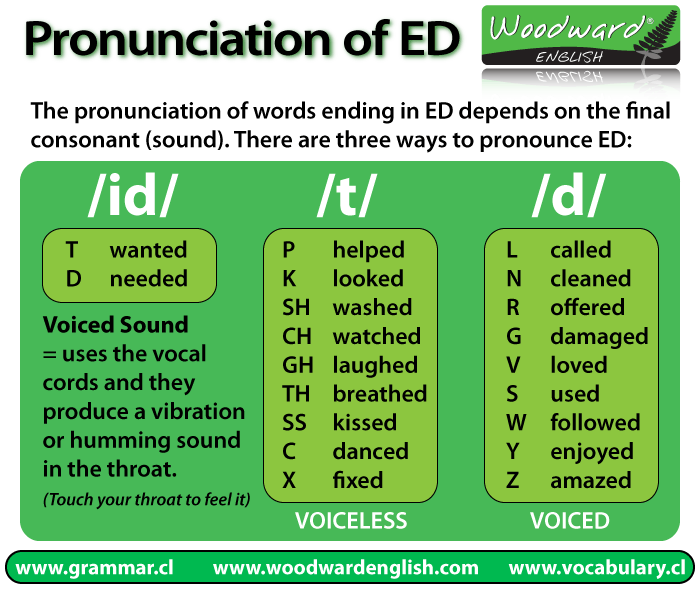
How to pronounce ed endings
http://www.woodwardenglish.com/wp-content/uploads/2012/11/pronunciation-of-ed-in-english.gif
Read this list and add the proper ending sound
http://img.docstoccdn.com/thumb/orig/100181909.png
https://theenglishprojectedu.files.wordpress.com/2015/01/regular-verbs.jpg
Assessment on Listening
Listening Assessment 1
http://www.elllo.org/english/1251/1258-Hana_Daniel-Holidays.htm
Past Simple Explanation
Videos
A. Past Simple Explanation (British)
https://www.youtube.com/watch?v=0Ri3QTT41f8
B. Past Simple Explanation (Spanish)
https://www.youtube.com/watch?v=RI0W_AqYZlQ
C. Past Simple: Making Questions (Pronunciation Practice)
https://www.youtube.com/watch?v=ghOQvAi3ZtQ
D. Telling a story in past simple
https://www.youtube.com/watch?v=dekQYgRjrZw
E. Past Simple: IN SONGS!
https://www.youtube.com/watch?v=FuPl4RxZEok
https://www.youtube.com/watch?v=IKBys9Pd-6w
https://www.youtube.com/watch?v=gNaDvAYC0Jw (Teacher Rapping irregular verbs)
F. Past Tense: English with Sound and Light (Many examples of the past)
https://www.youtube.com/watch?v=6-XNvlR_YEY
ED Ending Pronunciation
Espresso English
https://www.youtube.com/watch?v=X95t46xhHw0
Pronunciation of ED Guide
https://s-media-cache-ak0.pinimg.com/originals/76/27/fc/7627fcc0df3de25af4e95d22390db8b5.gif

Dictation Game:
Listening Exercises
Listening Simple Past about Maggie's Experience in Puerto Rico
https://en.islcollective.com/resources/printables/worksheets_doc_docx/listening_simple_past_exercise/past-simple-simple/25094
Many Examples of Past Simple
http://www.tolearnenglish.com/exercises/exercise-english-1/exercise-english-289.php
Alfie took a driving test for the second time.
http://learnenglishteens.britishcouncil.org/grammar-vocabulary/grammar-videos/past-simple-regular-verbs
What did Tom and Lisa do?
http://www.ivoox.com/listening-on-past-simple-audios-mp3_rf_1562747_1.html
Rafa Nadal Biopic
http://www.autoenglish.org/listening/RafaNadal.htm
Regular Verbs Pronunciation Check
http://www.bbc.co.uk/worldservice/learningenglish/radio/specials/1413_gramchallenge26/page2.shtml
Reading Material
A. Past Simple Basic Formation
http://www.perfect-english-grammar.com/past-simple.html
B. Past Simple Explanation
http://www.englishpage.com/verbpage/simplepast.html
C. Past Simple Irregular Verbs
https://learnenglish.britishcouncil.org/en/english-grammar/verbs/past-tense/past-simple
D. Past Simple Verb Change and Pronunciation
http://www.curso-ingles.com/gramatica-inglesa/pasado.php
E. Past Simple Explanation (Spanish)
http://www.inglessencillo.com/pasado-simple
Grammar Exercises
A. Grammar Exercises: Simple Past Tense
http://www.myenglishpages.com/site_php_files/grammar-exercise-simple-past.php
B. Cristiano Ronaldo and Leo Messi Biographies
http://www.englishexercises.org/makeagame/viewgame.asp?id=6066
C. Was/Were Exercies
http://www.agendaweb.org/verbs/tobe-past-simple/index.html
https://www.ego4u.com/en/cram-up/grammar/simple-past/exercises?03
http://www.perfect-english-grammar.com/past-simple-exercise-2.html
D. Past Simple Regular Verbs
http://www.agendaweb.org/verbs/past-simple-regular/index.html
http://www.montsemorales.com/gramatica/PastSregular1y2.htm
http://www.montsemorales.com/gramatica/PastSimpAffRegSw2-4.htm
F. Past Simple Irregular Verbs
http://www.agendaweb.org/exercises/verbs/irregular-past-1.htm
http://www.web-esl.com/Verbs/verbs1.htm
http://oudwww.bonhoeffer.nl/engels/2eklas/unit3/2un3iv.htm
Games
A. Snakes and Ladders
http://www.eslgamesworld.com/members/games/grammar/New_Snakes_%20Ladders/Past_simple_tense.html
B. Change the verb to past
http://www.eslgamesworld.com/members/games/grammar/perfectpast/New/past%20simple%20practice%20game.html
C. Jeopardy
http://www.englishmedialab.com/GrammarGames/perfectpast/past%20simple%20betting.html
D. Application with game like memory (Recommended)
http://www.mes-games.com/past1.php
Worksheets
Verb tense and meaning
https://f6c7z5k9.map2.ssl.hwcdn.net/wuploads/preview_new/full_10632_past_simple_tense_fully_editable__with_key_1.jpg

British Reading of Past Simple
https://f6c7z5k9.map2.ssl.hwcdn.net/wuploads/preview_new/full_16165_past_simple_regular_verbs_reading_1.jpg

Oregon Trail Reading - Difficult
https://englishvillage.files.wordpress.com/2012/10/the-oregon-trail-1.jpg

Link to many past simple worksheets.
http://first-english.org/english_learning/english_tenses/simple_past_worksheets/a_simple_past_worksheets.htm
Exercise Worksheet Link
http://farmacia.unich.it/farmacologia/didattica/inglese/worksheets.pdf
Pronunciation Practice
How to pronounce ed endings
http://www.woodwardenglish.com/wp-content/uploads/2012/11/pronunciation-of-ed-in-english.gif
Read this list and add the proper ending sound
http://img.docstoccdn.com/thumb/orig/100181909.png

https://theenglishprojectedu.files.wordpress.com/2015/01/regular-verbs.jpg

Assessment on Listening
Listening Assessment 1
http://www.elllo.org/english/1251/1258-Hana_Daniel-Holidays.htm
Listen to the conversation between Hana and Daniel and answer the questions. Answer using complete sentences.
1) What did Daniel do in Taiwan?
2) Who did he go with?
3) How was the local food in Taiwan?
4) How long did he go for?
5) Why did he go to Taiwan?
Assessment on Writing
Write a paragraph describing your favorite holiday vacations. Follow the questions to cover up the information and if there are some details you don't remember, just invent them.
1) What was your favorite holiday vacation in your life?
2) Where did you go on that vacation?
3) Who did you go with?
4) How did you travel to that destination?
5) How long was the trip to get there?
6) Where did you stay?
7) What did you do in that vacation? (Include 3 activities)
8) What did you eat and drink?
9) What was the best moment?
10) What was the worst moment?
Example:
My favorite holiday vacation was when I was 12 during Christmas. I went to Merida, a very beautiful mountainous city. I was with my dad, mom, brother, aunt, uncle and some cousins. We traveled in a car caravan of three. It took about 6 hours there, we stopped in different places to rest on the road. We stayed in a big family hotel called Magdalena. We hiked to the Pico Bolivar, visited the local zoo and tried different restaurants. We ate a lot of typical food, grilled meat, and drank hot chocolate. The best moment was when we visited the mountains because the view was amazing. The worst moment was when my brother and I got fever, called "Fiebre del Páramo", and had to go back to the hotel.
Assessment on Speaking: Prepare a presentation about an artist that you like and describe their story. Since we are working on past forms, the artist has to be a deceased one to avoid time use confusion. The presentation is going to be divided in 5 parts.
1) Introduce the artist.
Say who the artist is, why he/she is famous and why do you like him/her.
Example: Michael Jackson was the King of Pop. He was a very famous singer and dancer. I like this artist because I really like his music.
2) First Steps
Talk about his/her origins.
Example: Michael Jackson was born in Los Angeles, California, in 1958. His mother was Katherin Jackson and his dad was Joe Jackson. He lived in a small house with his three sisters and six brothers.
3) Artistic Career
Talk about his/her career.
Example: Michael Jackson career started in the child band called "The Jackson 5". They sang and danced pop song and had many hit songs. After the band split up, Michael Jackson began a solo career where he hand numerous great songs. During the 80s and 90s, he was seen as the King of Pop for his many successful videos, performances and for having record sales in different albums.
4) Historic Events
Talk about his/her best hits, movies, songs, moments, shows or actions.
Example: Michael Jackson's biggest hit was Thriller. Thriller was one of the most expensive and elaborated videos of its era, but also one of the most popular.The album where this single was released sold millions of copy.
5) Dead
Talk about his/her dead.
Michael Jackson died in June 2009. He died due to the misused of certain drugs by his personal doctor. His dead was a very sad event in the history of music and thousands of people went to his funeral. Nowadays, MJ is remember as a Pop Legend and an idol.
Assessment on Writing
Write a paragraph describing your favorite holiday vacations. Follow the questions to cover up the information and if there are some details you don't remember, just invent them.
1) What was your favorite holiday vacation in your life?
2) Where did you go on that vacation?
3) Who did you go with?
4) How did you travel to that destination?
5) How long was the trip to get there?
6) Where did you stay?
7) What did you do in that vacation? (Include 3 activities)
8) What did you eat and drink?
9) What was the best moment?
10) What was the worst moment?
Example:
My favorite holiday vacation was when I was 12 during Christmas. I went to Merida, a very beautiful mountainous city. I was with my dad, mom, brother, aunt, uncle and some cousins. We traveled in a car caravan of three. It took about 6 hours there, we stopped in different places to rest on the road. We stayed in a big family hotel called Magdalena. We hiked to the Pico Bolivar, visited the local zoo and tried different restaurants. We ate a lot of typical food, grilled meat, and drank hot chocolate. The best moment was when we visited the mountains because the view was amazing. The worst moment was when my brother and I got fever, called "Fiebre del Páramo", and had to go back to the hotel.
Assessment on Speaking: Prepare a presentation about an artist that you like and describe their story. Since we are working on past forms, the artist has to be a deceased one to avoid time use confusion. The presentation is going to be divided in 5 parts.
1) Introduce the artist.
Say who the artist is, why he/she is famous and why do you like him/her.
Example: Michael Jackson was the King of Pop. He was a very famous singer and dancer. I like this artist because I really like his music.
2) First Steps
Talk about his/her origins.
Example: Michael Jackson was born in Los Angeles, California, in 1958. His mother was Katherin Jackson and his dad was Joe Jackson. He lived in a small house with his three sisters and six brothers.
3) Artistic Career
Talk about his/her career.
Example: Michael Jackson career started in the child band called "The Jackson 5". They sang and danced pop song and had many hit songs. After the band split up, Michael Jackson began a solo career where he hand numerous great songs. During the 80s and 90s, he was seen as the King of Pop for his many successful videos, performances and for having record sales in different albums.
4) Historic Events
Talk about his/her best hits, movies, songs, moments, shows or actions.
Example: Michael Jackson's biggest hit was Thriller. Thriller was one of the most expensive and elaborated videos of its era, but also one of the most popular.The album where this single was released sold millions of copy.
5) Dead
Talk about his/her dead.
Michael Jackson died in June 2009. He died due to the misused of certain drugs by his personal doctor. His dead was a very sad event in the history of music and thousands of people went to his funeral. Nowadays, MJ is remember as a Pop Legend and an idol.
sábado, 11 de abril de 2015
002 - The Weather (Kids Lesson)
Prezi Presentation on the World Weather
https://prezi.com/ae0qodfmjov_/the-world-weather/
Games
The Weather Maze
http://learnenglishkids.britishcouncil.org/es/fun-games/weather-maze
How's the weather?
http://learnenglishkids.britishcouncil.org/es/fun-games/whats-the-weather
Hangman: Weather Words
http://learnenglishkids.britishcouncil.org/es/word-games/hangman/weather
The Weather Transformer
http://pbskids.org/catinthehat/games/weather-transformer.html
Pirate Boardgame: Weather Vocabulary
http://www.eslgamesplus.com/weather-vocabulary-esl-interactive-board-game/
Activities
Weather Forecast
https://f6c7z5k9.map2.ssl.hwcdn.net/wuploads/preview_new/full_29652_weather_forecasts_1.jpg

viernes, 10 de abril de 2015
001 - Working on Conditionals
Working on Conditionals Compilation
Disclaimer: This is a compilation of digital materials found on the net made for being used in English class as extracurricular study material and nothing else. All sources are indicated.
Conditional Sentences are also known as Conditional Clauses or If Clauses. They are used to express that the action in the main clause (without if) can only take place if a certain condition (in the clause with if) is fulfilled. There are three types of Conditional Sentences.
Source Material: https://www.ego4u.com/en/cram-up/grammar/conditional-sentences
The Zero Conditional
We can make a zero conditional sentence with two present simple verbs (one in the 'if clause' and one in the 'main clause'):
- If + present simple, .... present simple.
This conditional is used when the result will always happen. So, if water reaches 100 degrees, it always boils. It's a fact. I'm talking in general, not about one particular situation. The result of the 'if clause' is always the main cluase.
The 'if' in this conditional can usually be replaced by 'when' without changing the meaning.
For example: If water reaches 100 degrees, it boils. (It is always true, there can't be a different result sometimes). If I eat peanuts, I am sick. (This is true only for me, maybe, not for everyone, but it's still true that I'm sick every time I eat peanuts)
Here are some more examples:
|
The first conditional has the present simple after 'if', then the future simple in the other clause:
- if + present simple, ... will + infinitive
- ...will + infinitive if + present simple
The First Conditional
The first conditional has the present simple after 'if', then the future simplein the other clause:
- if + present simple, ... will + infinitive
It's used to talk about things which might happen in the future. Of course, we can't know what will happen in the future, but this describes possible things, which could easily come true.
- If it rains, I won't go to the park.
- If I study today, I'll go to the party tonight.
- If I have enough money, I'll buy some new shoes.
- She'll be late if the train is delayed.
- She'll miss the bus if she doesn't leave soon.
- If I see her, I'll tell her.
The Second Conditional
The second conditional uses the past simple after if, then 'would' and the infinitive:
- if + past simple, ...would + infinitive
(We can use 'were' instead of 'was' with 'I' and 'he/she/it'. This is mostly done in formal writing).
It has two uses.
First, we can use it to talk about things in the future that are probably not going to be true. Maybe I'm imagining some dream for example.
- If I won the lottery, I would buy a big house.(I probably won't win the lottery)
- If I met the Queen of England, I would say hello.
- She would travel all over the world if she were rich.
- She would pass the exam if she ever studied.(She never studies, so this won't happen)
Second, we can use it to talk about something in the present which is impossible, because it's not true. Is that clear? Have a look at the examples:
- If I had his number, I would call him. (I don't have his number now, so it's impossible for me to call him).
- If I were you, I wouldn't go out with that man.
The Third Conditional
We make the third conditional by using the past perfect after 'if' and then 'would have' and the past participle in the second part of the sentence:
- if + past perfect, ...would + have + past participle
It talks about the past. It's used to describe a situation that didn't happen, and to imagine the result of this situation.
- If she had studied, she would have passed the exam (but, really we know she didn't study and so she didn't pass)
- If I hadn't eaten so much, I wouldn't have felt sick (but I did eat a lot, and so I did feel sick).
- If we had taken a taxi, we wouldn't have missed the plane
- She wouldn't have been tired if she had gone to bed earlier
- She would have become a teacher if she had gone to university
- He would have been on time for the interview if he had left the house at nine
Source Material: http://www.perfect-english-grammar.com/
Video Material
First ConditionalFirst Conditional Extra Explanation
https://www.youtube.com/watch?v=9ifCM8kJFKI
Wall Street Tutor
First Conditional Examples
https://www.youtube.com/watch?v=fSDxMaC0QYc
Hercules Scenes
First Conditional Song Examples
https://www.youtube.com/watch?v=SC8hSPY9YPY
Second Conditional
Second Conditional Extra Explanation
https://www.youtube.com/watch?v=YEwcIsTKBU4
Second Conditional Extra Explanation and Examples
https://www.youtube.com/watch?v=ry3xEVEiF-0
LOiEnglish
What would do if you....?
https://www.youtube.com/watch?v=kOSNTqHHXPA
Second Conditional Examples
https://www.youtube.com/watch?v=VJF9Gb3dGbc
Big Bang Theory
Second Conditional in Songs
https://www.youtube.com/watch?v=Xq2l4hpSZpo
Third Conditional
Teacher Diane's Explanation
https://www.youtube.com/watch?v=RuUkuORtfE0
Marcnet Explanation
https://www.youtube.com/watch?v=DsOTuLOfPQc
Once upon a time third conditional examples
https://www.youtube.com/watch?v=NnONBkEQUU0
Benjamin Button conditional examples
https://www.youtube.com/watch?v=JZj1Yeb-tVg
Third Conditional Examples in Songs
https://www.youtube.com/watch?v=xlIEwi9e7mQ
Practice Material
Zero Conditional Practicehttp://www.englishgrammarsecrets.com/type0/exercise1.swf
http://www.englishgrammarsecrets.com/type0/exercise2.swf
http://www.esltower.com/GRAMMARQUIZ/preintermediate/zero%20conditional.htm
https://elt.oup.com/student/solutions1stedition/preint_unit_page/unit6/grammar/exercise2?cc=us&selLanguage=en
http://www.perfect-english-grammar.com/support-files/conditionals_zero_form.pdf
First Conditional Practice
http://www.english-grammar-lessons.com/firstconditional/exercise1.swf
http://www.english-grammar-lessons.com/firstconditional/exercise2.swf
http://www.english-grammar-lessons.com/firstconditional/exercise3.swf
http://www.impact-english.com/members/Grammar_Practice/Always/test-grammar/gr_prac_form-Cond1.htm
http://www.perfect-english-grammar.com/first-conditional-exercise-1.html
Second Conditional Practice
http://www.englishgrammarsecrets.com/type0/exercise2.swf
http://www.english-grammar-lessons.com/firstconditional/exercise3.swf
http://www.english-grammar-lessons.com/secondconditional/exercise4.swf
http://www.englishgrammarsecrets.com/secondconditional/exercise4.swf
http://www.montsemorales.com/gramatica/Condition2-Imag4-22-1.htm
http://www.perfect-english-grammar.com/second-conditional-exercise-1.html
Third Conditional Practice
http://www.english-grammar-lessons.com/thirdconditional/exercise1.swf
http://www.english-grammar-lessons.com/thirdconditional/exercise4.swf
http://www.english-grammar-lessons.com/thirdconditional/exercise3.swf
http://www.bnv-bamberg.de/home/ulrich.koch/flg/englischinteraktiv/ifclauses2a.htm
http://www.better-english.com/grammar/cond2.htm
http://www.perfect-english-grammar.com/third-conditional-exercise-1.html
Games
The Conditional Rallyhttp://www.eslgamesplus.com/conditionals-review-rally/
Fling the teacher
http://eslgamesworld.com/members/games/grammar/fling%20the%20teacher/conditionals/conditionals%20practice.html
Who wants to be a conditional billionaire
http://eslgamesworld.com/members/games/ClassroomGames/Billionaire/Conditionals%20Billionaire%20Game/index.html
Assessment on Conditionals
First Conditional: Create a business that sells its products on a website. Design the logo, the brand, products to be sold and other details and create a presentation to be shown on the classroom screen. Explain how will you call your company, what will it sell, the clients you are trying to reach and end with a phrasing describing why people will buy things using conditionals.
Example: If you love pizza, you should come to...
If you have a lot of money, you will enjoy these...
If you cannot find a place to buy books, you might find it...
Second Conditional: You are going to be presented with 5 possible unreal situations, pick one of them and then describe how they would change your life and what you would do different in that context. Describe the situation with your opinions and second conditionals.
Situations: How would your life change if you...
... became incredibly rich for winning a lotto ticket?
... obtained superpowers from a meteorite? (Pick a power)
... were sent to study to an unexpected country? (Pick a country)
... became a personality celebrity from a viral video?
... obtained a seat of power in the government? (Pick the post)
Third Conditional: Choose one of the situations presented and then describe how the world would have changed if those events had happened. Write at least an essay of 120 words and rememeber to write an introduction, body and conclusion.
- What would have happened if the Nazis had won World War 2?
- What would have happened if electricity hadn't beend discovered?
- What would have happened if South American countries hadn't achieve independence?
- What would have happened if Cuban missile crisis had started a nuclear war?
- What would have happened if Pangea had still existed?
Listening Assessment for Third Conditional: You've got to find what you love.
https://blogger.googleusercontent.com/img/b/R29vZ2xl/AVvXsEhsMnDVGGpGiC-PtCyMh0Ftqd3COMX4garWdHNMiYe_n9-VV0VnuFFv-68SC7qVC82ggPTeU5u_tRiafKcKcZFnVbmTAq8QJ8k08sDyBuOQgNIRa6N5Ma5WuEFuatsKtK_ppSF2FGlgIVre/s1600/steve+jobs.jpg
- What would have happened if the Nazis had won World War 2?
- What would have happened if electricity hadn't beend discovered?
- What would have happened if South American countries hadn't achieve independence?
- What would have happened if Cuban missile crisis had started a nuclear war?
- What would have happened if Pangea had still existed?
Listening Assessment for Third Conditional: You've got to find what you love.
https://blogger.googleusercontent.com/img/b/R29vZ2xl/AVvXsEhsMnDVGGpGiC-PtCyMh0Ftqd3COMX4garWdHNMiYe_n9-VV0VnuFFv-68SC7qVC82ggPTeU5u_tRiafKcKcZFnVbmTAq8QJ8k08sDyBuOQgNIRa6N5Ma5WuEFuatsKtK_ppSF2FGlgIVre/s1600/steve+jobs.jpg

Suscribirse a:
Entradas (Atom)